
Survey first: $300–$750
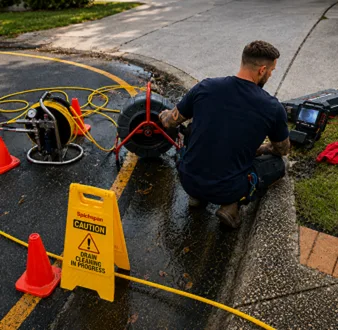
A recorded camera run with distances marked. Yours to keep, and usually credited if the work goes ahead.
A cracked or root-damaged drain does not have to mean a trench through the garden. A resin liner is cured inside the existing pipe from an access point you already have, sealing every joint along the run, and the surface above is never touched.
Relining is a structural repair, not a cleaning method, and the distinction matters when you are comparing quotes. Jetting restores flow through a pipe that is still cracked. A liner restores the pipe.
That also means it is not always the answer. It cannot correct a run that has sagged or lost its fall, and it has nothing to line against where a section has collapsed. A camera survey separates those cases in about an hour, and the answer changes the cost by a multiple.
Excavation close to the foreshore brings problems that have nothing to do with plumbing: unstable saturated ground, dewatering, restricted access down a narrow lot, and reinstatement of landscaping that was not cheap to build.
The trenchless comparison is not repair against repair. It is repair against repair plus everything sitting on top, and on a waterfront block that second half is usually the bigger number.
This is the honest limit of the method. A liner follows the pipe it is cured inside. If the run has sagged into a belly or lost its fall, relining seals it and leaves the shape exactly as it was, so the water still pools where it pooled before.
East-coast lows send torrents down the slopes off the Barrenjoey Road ridge, overloading stormwater pits on the steep streets above both shorelines.
On sloping ground that failure mode is common enough to check for specifically. Where the profile is wrong, the correct answer is excavation and re-lay of that section, and we will tell you so even though it is the more expensive quote.
Once is weather. Twice is a defect, and the second event is the point at which paying for a camera saves money rather than costing it.
What we are looking for is specific: a belly holding water, a joint that has opened, a section crushed by a vehicle crossing. Each has a different answer, and only one of them is relining. Knowing which you have is worth more than another clear.
Removing a mature tree is expensive, often needs approval, and frequently does not solve it: the roots already inside the pipe do not leave when the trunk does, and the joint is still open for the next one.
The cabbage tree palms and mature figs that define Palm Beach push thirsty roots into ageing joints, especially around older weekender-era plumbing.
Relining lets both things be true at once. The garden stays as it is and the drain stops being a route to water. For most owners that is the whole appeal, and it is why no-dig gets specified on established blocks far more often than on new ones.
The peninsula’s sandy soil migrates through cracks in older pipes, silting up sewer and stormwater lines until flow slows to nothing.
Ground near water holds more of it, sits lower and moves more through the seasons than ground further up. Pipework laid decades ago has been flexed by that movement for its whole life, and joints open a fraction at a time rather than failing all at once.
It is why faults here tend to arrive as a slow decline rather than a sudden break, and why a camera often finds a run that is uniformly tired instead of one obvious defect. That pattern suits a full-length liner rather than a patch.
Root intrusion is not automatically a relining job. If the roots are fine and the pipe behind them is sound, a cut and jet with a maintenance interval can be the right call for years.
What moves it to relining is structural: an open joint you can see daylight through, a cracked barrel, or a run that has been cleared repeatedly at shortening intervals. Anyone quoting a liner without showing you the inside of the pipe is guessing, and you should ask for the footage.
It is not a universal fix and anyone presenting it as one is selling rather than advising. A liner follows the shape of the host pipe, so it cannot correct a run that has lost its fall or sagged into a belly. A collapsed section has nothing to line against. A pipe crushed badly out of round has to be replaced.
In those cases the right answer is excavation, and we would rather quote that and be trusted than reline something that will disappoint you in two years.
A recorded camera run with distances marked. Yours to keep, and usually credited if the work goes ahead.
The prevailing 2026 Sydney range for residential sewer relining.
Proportionate for one fault in a sound run. We will recommend it over a full liner when that is what the camera shows.
For a run failing along its length, which on old clay is the common finding.
Plus reinstatement. On a bare lawn it can win. Under anything you would miss, it usually does not.
These are market ranges, not our price. Nothing is quoted before the survey, and nothing starts before you agree it. Figures here are indicative of the 2026 Sydney market rather than a quote from us, you get your own number as a fixed price before any work starts.

A CCTV survey establishes the material, the diameter, where the defects are and how far they sit from the access. You see the footage, and it is what the quote is built from.
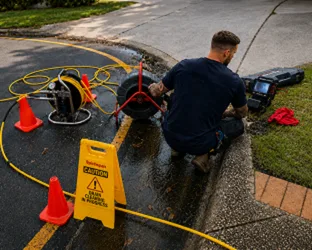
Patch or full length, and occasionally excavation instead. We will tell you when digging is the better answer even though it is the bigger quote.
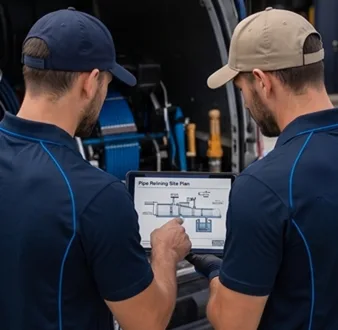
The run is jetted so the liner bonds to pipe rather than debris, the liner is installed through the existing access, and it cures in place. Most domestic jobs are a single day.

Every branch the liner passed is reopened from inside, then the run is cameraed again so you can see it is continuous and the junctions are clear.
Describe what the drain is doing and how often. We will tell you whether it sounds structural or whether a clean and a maintenance interval is the honest answer.
Cost, lifespan, method, and the cases where a liner is the wrong answer.

Call for the fastest answer, or send the form and we will arrange a camera survey before anything is quoted.

Leave your details and our local Palm Beach team will call you back fast.